If you are planning to enter the cryptocurrency market, one of the first things you will notice is that almost every exchange offers two major ways to trade. These are spot trading and futures trading. At first, I thought they were almost the same because both involve buying and selling cryptocurrencies. However, after spending time learning about both, I realized they are completely different in terms of risk, strategy, and profit potential.
Many beginners jump into futures trading because they hear stories about traders making huge profits in a short time. Unfortunately, they often ignore the risks involved. On the other hand, spot trading is much simpler and usually the better choice for someone who is just starting.
In this article, I will explain the difference between spot trading and futures trading in simple words. I will also share my thoughts on which option is better depending on your experience and goals.
What Is Spot Trading
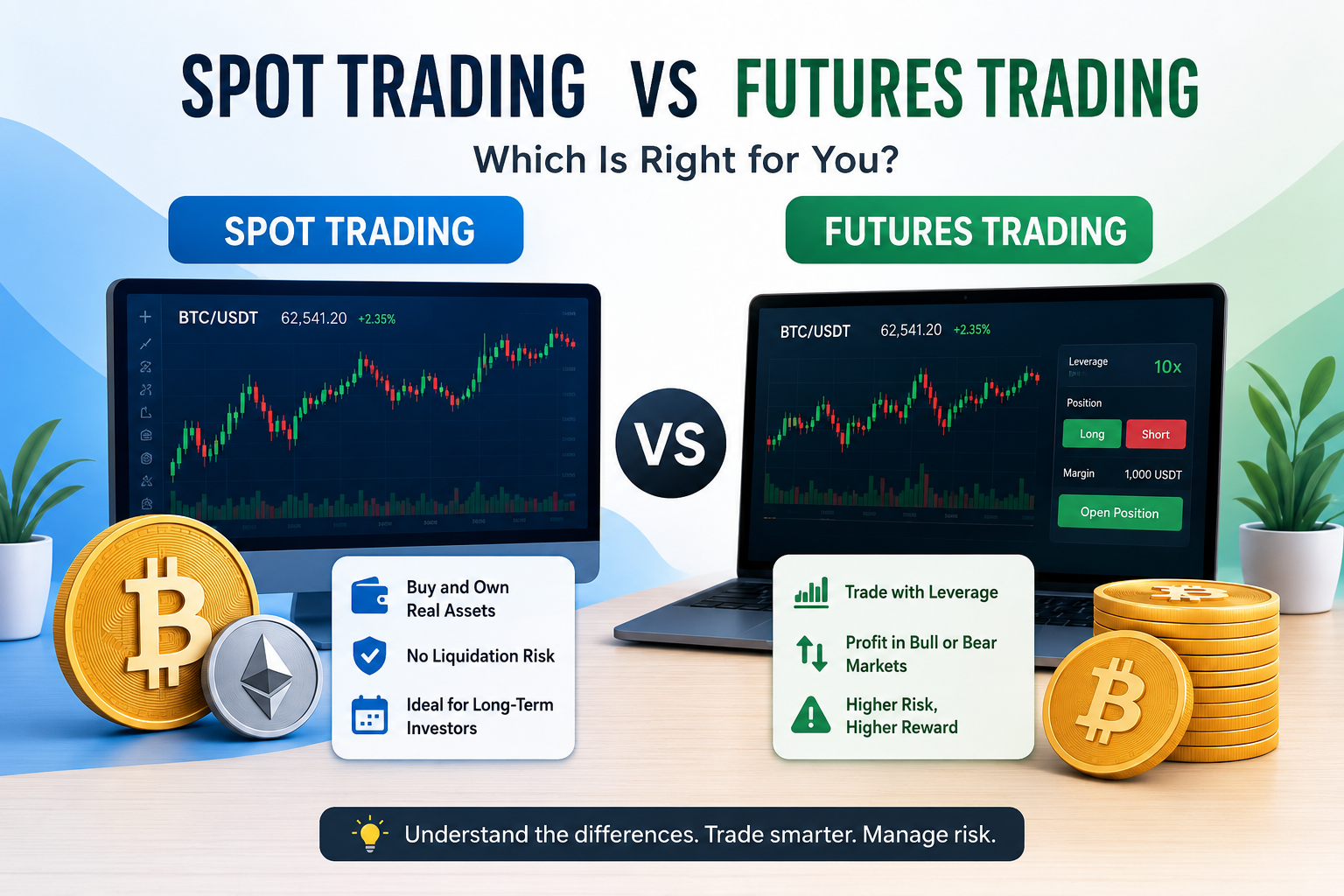
Spot trading is the simplest form of trading. When I buy a cryptocurrency through spot trading, I become the actual owner of that asset. If I purchase one Bitcoin, that Bitcoin belongs to me until I decide to sell it.
The transaction happens at the current market price. Once the purchase is complete, I can transfer my coins to another wallet, hold them for years, or sell them whenever I want.
For example, if Bitcoin is trading at $60,000 and I buy one Bitcoin, I now own one Bitcoin worth $60,000. If the price later rises to $70,000, I can sell it and make a profit of $10,000. If the price falls to $50,000, I will have an unrealized loss until I decide to sell.
This type of trading is very easy to understand because I am simply buying an asset and selling it later.
What Is Futures Trading
Futures trading is completely different. Instead of buying the actual cryptocurrency, I trade a contract based on the future price of that asset.
This means I do not actually own Bitcoin or Ethereum. I only predict whether the price will move up or down.
If I believe Bitcoin will increase in value, I open a long position.
If I think Bitcoin will fall, I open a short position.
This makes futures trading unique because I can potentially earn profits in both rising and falling markets.
Another important feature of futures trading is leverage. Leverage allows me to control a much larger position using only a small amount of money.
For example, if I have $100 and use 10x leverage, I can open a trade worth $1,000.
While this can increase profits, it also increases losses. A small market movement against my position can wipe out my entire investment.
Ownership Difference
The biggest difference between spot and futures trading is ownership.
With spot trading, I actually own the cryptocurrency.
With futures trading, I never own the asset. I only trade a contract that follows its price.
This difference becomes very important if I plan to hold cryptocurrencies for several years or transfer them to another wallet.
Spot trading allows me to do that.
Futures trading does not.
Risk Level
In my opinion, risk is where these two trading methods become completely different.
Spot trading is generally much safer.
Even if the market crashes, I still own my cryptocurrency. I can simply wait for prices to recover.
There is no expiration date forcing me to sell.
Futures trading is much riskier.
If the market moves against my prediction, I can lose my entire margin within minutes.
Many traders experience liquidation.
Liquidation means the exchange automatically closes the position because the losses become too large.
This is one reason why beginners often lose money in futures trading.
Profit Potential
Many people choose futures trading because of its higher profit potential.
Since leverage increases the size of my position, even a small price movement can generate significant profits.
For example, a five percent price increase with 20x leverage could produce a profit close to one hundred percent on my invested margin.
However, the opposite is also true.
A five percent move against my trade could completely eliminate my investment.
Spot trading usually generates slower returns.
Since there is no leverage, profits grow according to the actual market movement.
Although this may seem less exciting, it is much safer over the long term.
Leverage Explained
Leverage is probably the most attractive feature of futures trading.
Imagine I only have $500.
Without leverage, I can only buy $500 worth of Bitcoin.
With 10x leverage, I can control $5,000 worth of Bitcoin.
If the market moves in my favor, my profits become much larger.
However, leverage works both ways.
Even a small mistake can result in heavy losses.
That is why professional traders always use risk management and avoid excessive leverage.
Personally, I believe beginners should stay away from high leverage until they fully understand how the market behaves.
Long and Short Positions
One advantage of futures trading is the ability to profit from both market directions.
If I think prices will rise, I open a long position.
If I believe prices will fall, I open a short position.
Spot trading only allows me to benefit when prices increase.
If the market is falling, I usually have only two options.
I can sell my assets or wait patiently for the market to recover.
This flexibility makes futures trading attractive for experienced traders who understand market trends.
Holding Period
Spot trading has no time limit.
I can hold my cryptocurrency for days, months, or even years.
Many long term investors simply buy quality coins and forget about them until the next bull market.
Futures trading is usually designed for shorter trading periods.
Many traders keep positions open for only a few hours or a few days.
Holding futures positions for a long time may also involve funding fees, which reduce profits over time.
Emotional Pressure
From my experience, futures trading is far more stressful.
Prices move quickly.
Leverage increases both profits and losses.
Every market movement feels more intense.
Many beginners panic and make emotional decisions.
Spot trading feels much more relaxed.
If prices fall, I can simply wait.
I do not constantly worry about liquidation or margin requirements.
This makes spot trading much easier for people who have full time jobs or cannot watch charts all day.
Capital Requirements
Spot trading is suitable for almost everyone.
Even with a small investment, I can buy cryptocurrency and slowly build my portfolio.
Futures trading also allows small deposits because of leverage.
However, using leverage with a small account often encourages traders to take unnecessary risks.
Many people lose their entire balance because they try to turn a small investment into a large fortune too quickly.
Patience usually produces better long term results.
Best Choice for Beginners
Whenever someone asks me which trading method they should start with, my answer is almost always spot trading.
It is easier to understand.
The risks are lower.
There is no liquidation.
I actually own the cryptocurrency.
I also get enough time to learn about market cycles without worrying about losing everything overnight.
Once I become comfortable with technical analysis, market psychology, and risk management, only then would I consider learning futures trading.
Best Choice for Experienced Traders
Experienced traders may prefer futures trading because it offers more flexibility.
They can profit during both bull and bear markets.
They can hedge their investments.
They can use leverage carefully to increase returns.
However, even professional traders understand that futures trading carries significant risk.
Successful traders focus on protecting their capital before thinking about profits.
Advantages of Spot Trading
Spot trading is simple to understand.
I own the cryptocurrency.
There is no liquidation risk.
It is ideal for long term investing.
It creates less emotional stress.
It is beginner friendly.
Advantages of Futures Trading
Futures trading allows profits in both rising and falling markets.
Leverage can increase returns.
Professional traders can hedge existing investments.
It provides more advanced trading opportunities.
Disadvantages of Spot Trading
Profits may take longer.
I cannot directly profit from falling prices.
Large returns usually require significant market growth.
Disadvantages of Futures Trading
Leverage increases losses.
Liquidation is possible.
Emotional pressure is much higher.
Funding fees may reduce profits.
It requires strong knowledge of technical analysis and risk management.
Final Thoughts
After comparing both trading methods, I believe there is no single option that is perfect for everyone. The right choice depends on your experience, financial goals, and ability to manage risk.
If I am investing for the long term and want a safer approach, I always choose spot trading. It allows me to own real cryptocurrency, avoid liquidation, and stay calm during market volatility.
If I become an experienced trader with a solid strategy, proper discipline, and effective risk management, then futures trading can provide additional opportunities. However, I would never use high leverage without understanding the risks because protecting my capital is always more important than chasing quick profits.
My advice to every beginner is simple. Learn spot trading first. Understand how the crypto market works, practice patience, and build confidence. Once you have enough experience, you can explore futures trading with caution. In the world of cryptocurrency, knowledge and discipline are far more valuable than taking unnecessary risks in search of fast profits.