When I first started learning about blockchain technology, I often heard people comparing it with traditional databases. At the beginning, I thought both were almost the same because they both store data. However, after spending time understanding how each system works, I realized that they are built for completely different purposes. While both technologies manage and organize information, the way they store, protect, and share data is very different.
In my opinion, understanding the difference between blockchain and traditional databases is important for anyone interested in technology, cryptocurrency, or modern business systems. Many people assume blockchain is simply a better database, but that is not always true. Each system has its own strengths, weaknesses, and ideal use cases.
In this article, I will explain the major differences between blockchain and traditional databases in simple English so that even beginners can understand the concepts without confusion.
What Is a Traditional Database
A traditional database is a system used to store, organize, update, and retrieve information efficiently. Almost every company, school, hospital, bank, and online platform uses traditional databases to manage data.
For example, when I log into my email account, book a hotel room, or make an online purchase, the information is stored in a traditional database. These databases are managed by a central authority that controls who can access, edit, or delete the stored information.
Popular database systems include MySQL, PostgreSQL, Oracle Database, and Microsoft SQL Server. These systems have been used successfully for decades because they are fast, reliable, and easy to manage.
What Is Blockchain
Blockchain is also a system for storing data, but it works in a completely different way. Instead of storing information in tables controlled by one organization, blockchain stores data inside blocks that are connected together in chronological order.
Every new block contains a group of verified transactions along with a unique digital fingerprint that links it to the previous block. Because every block depends on the one before it, changing old information becomes extremely difficult.
Instead of one central server controlling everything, blockchain uses a distributed network where multiple computers keep identical copies of the same data. Every participant helps verify new information before it becomes part of the blockchain.
This decentralized approach is one of the biggest reasons blockchain has become popular.
Centralization Versus Decentralization
One of the biggest differences I noticed is how control is managed.
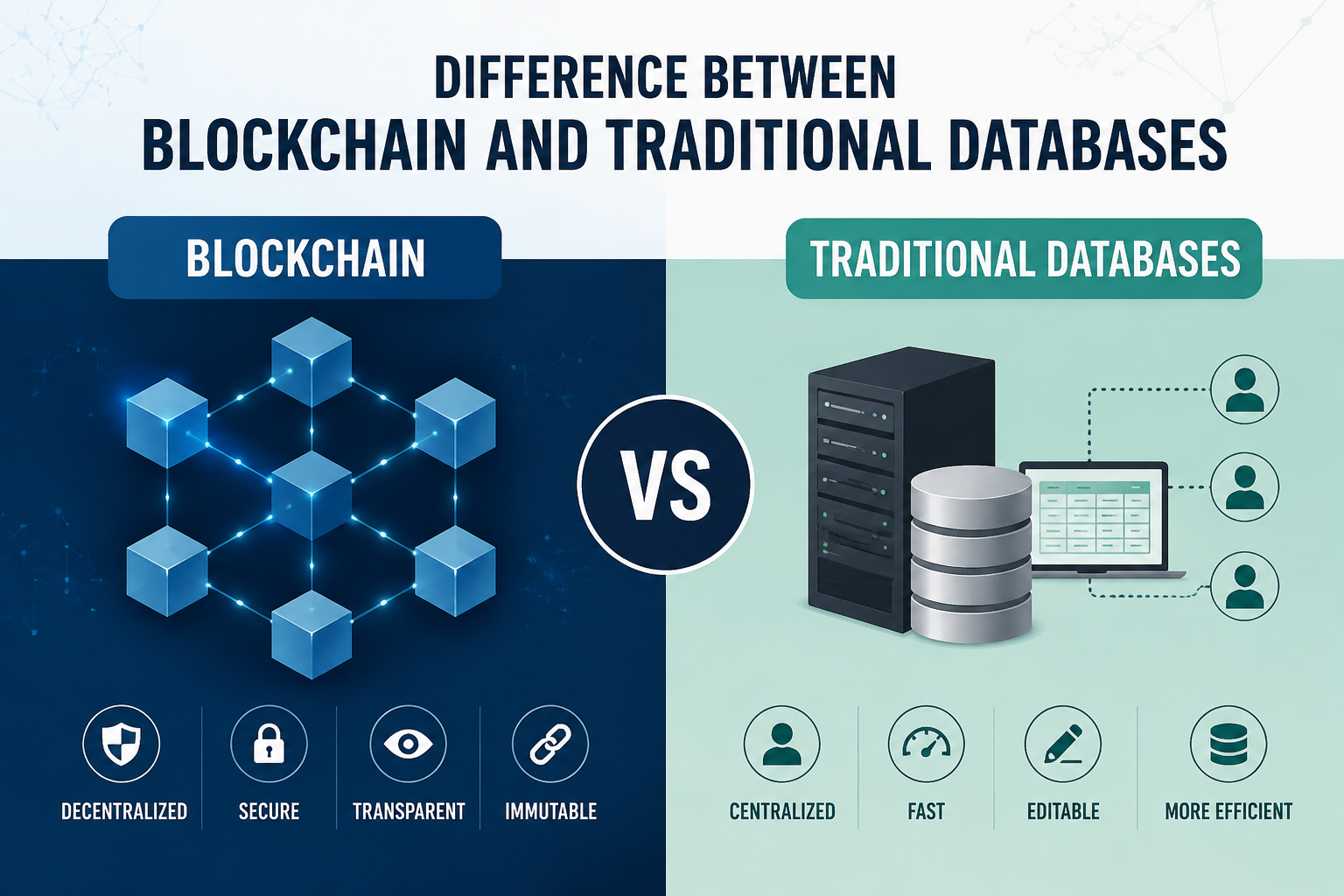
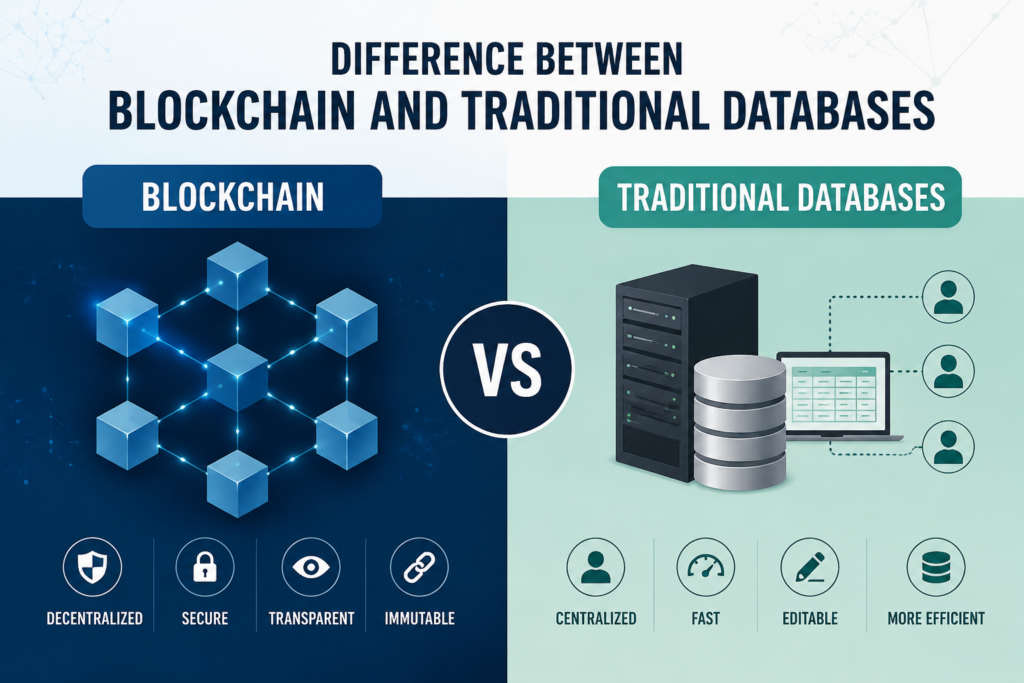
Traditional databases are centralized. This means one company or organization owns the server and controls the data. If a bank owns the database, the bank decides who can access information and who can make changes.
Blockchain is decentralized. Instead of one owner, many computers work together to maintain the network. Every participant stores a copy of the blockchain, making the system more transparent and resistant to manipulation.
Centralization offers simplicity and faster management, while decentralization provides greater trust among participants who may not know each other.
Data Modification
Traditional databases are designed to allow updates.
If a company notices incorrect customer information, employees can easily modify or delete the records. This flexibility makes traditional databases perfect for businesses that regularly update customer information, inventory, employee records, and financial reports.
Blockchain works differently.
Once information has been verified and added to the blockchain, it becomes nearly impossible to modify. Instead of changing previous records, new transactions are added that reflect updated information.
This creates a permanent history of every action that has taken place.
Transparency
Transparency is another area where blockchain stands out.
In many public blockchain networks, anyone can view transaction history. Although personal identities remain hidden behind wallet addresses, every transaction remains visible forever.
Traditional databases usually keep information private. Only authorized users can access sensitive data.
For example, my banking information is stored privately inside the bank’s database, and only approved employees can access it.
This difference makes blockchain ideal for situations where transparency is valuable.
Security
Both systems focus heavily on security, but they use different methods.
Traditional databases rely on firewalls, passwords, encryption, backups, and cybersecurity teams to protect data. If security measures are weak, hackers may gain access to the database.
Blockchain combines cryptography, distributed storage, and consensus mechanisms to secure information.
Since copies of the blockchain exist across many computers, attacking one server does not compromise the entire network. A hacker would need to control a large portion of the network simultaneously, which is extremely difficult in well established blockchain systems.
Speed
Traditional databases are generally much faster.
Banks, online stores, airline reservation systems, and hospitals process thousands of transactions every second using traditional databases.
Blockchain usually requires more time because transactions must be verified by multiple participants before becoming permanent.
For example, cryptocurrency transactions often take several minutes depending on network traffic, while a centralized database can update information almost instantly.
For applications where speed is essential, traditional databases usually perform better.
Trust Model
This is perhaps the most important difference.
Traditional databases require trust in the organization managing the data.
When I use online banking, I trust the bank to store my balance correctly and protect my financial information.
Blockchain reduces the need for trusting a single organization because the network itself verifies every transaction using predefined rules.
This feature makes blockchain especially useful when multiple organizations need to share information without relying on one central authority.
Data Structure
Traditional databases organize information into tables, rows, and columns.
This structure allows complex searching, sorting, filtering, and reporting with great efficiency.
Blockchain stores data in blocks connected together through cryptographic links.
Each block contains transactions, timestamps, and references to previous blocks.
Although blockchain stores information securely, it is not as flexible for handling complicated business queries compared to relational databases.
Scalability
Traditional databases can usually scale efficiently by upgrading servers or adding cloud infrastructure.
Companies can increase storage capacity and processing power as their business grows.
Blockchain networks often face scalability challenges because every participating computer must process and store large amounts of data.
Many blockchain developers continue working on solutions that improve transaction speed and network capacity without sacrificing security.
Cost
Traditional databases are generally less expensive for businesses.
Companies purchase servers, database software, cloud services, and hire database administrators to maintain operations.
Blockchain systems may require higher computing resources, specialized development, and continuous network participation.
Public blockchains may also involve transaction fees whenever new information is recorded.
Because of these costs, blockchain is not always the most economical solution.
Ownership of Data
In centralized databases, the organization owns and manages the information.
Users often depend on the company to protect their records and maintain system availability.
Blockchain gives participants greater control over their digital assets and transaction history.
Instead of relying entirely on one organization, ownership is distributed across the network according to blockchain rules.
This concept has become especially popular in cryptocurrency and decentralized finance.
Backup and Recovery
Traditional databases require scheduled backups.
If hardware fails or files become corrupted, administrators restore information from backup copies.
Blockchain naturally creates redundancy because every participating computer stores a copy of the ledger.
Even if several computers fail, the network continues operating using the remaining copies.
This design improves reliability.
Common Uses of Traditional Databases
Traditional databases remain the preferred choice for many industries.
They are widely used in banking systems, hospitals, universities, online shopping platforms, airline reservations, payroll systems, customer relationship management, accounting software, and inventory management.
These applications require high speed, flexible updates, and efficient searching.
Traditional databases meet these needs very well.
Common Uses of Blockchain
Blockchain shines in situations where transparency, security, and trust are more important than raw processing speed.
Popular blockchain applications include cryptocurrencies, supply chain tracking, digital identity management, smart contracts, healthcare record verification, decentralized finance, voting systems, and asset tokenization.
These industries benefit from permanent records that cannot easily be altered.
Advantages of Traditional Databases
From my perspective, traditional databases offer several important advantages.
They process information quickly.
They support complex searches.
They are easy to update.
They require fewer computing resources.
They are suitable for businesses that handle millions of customer records every day.
These strengths explain why traditional databases continue to dominate enterprise software.
Advantages of Blockchain
Blockchain also offers unique benefits.
It creates permanent records.
It improves transparency.
It reduces dependence on central authorities.
It strengthens security through cryptography.
It increases trust among participants who may never meet each other.
For industries requiring secure and verifiable records, blockchain provides significant value.
Limitations of Traditional Databases
Traditional databases also have weaknesses.
A central server can become a target for cyberattacks.
Users must trust the organization managing the information.
Internal employees with high level permissions may accidentally or intentionally modify important records.
These risks require strong cybersecurity practices.
Limitations of Blockchain
Blockchain is not perfect either.
Transactions can be slower.
Storage requirements continue growing.
Public networks may consume significant computing resources.
Development costs can be higher.
Some blockchain systems also face regulatory uncertainty depending on the country.
Because of these limitations, blockchain should only be used when its unique features provide real value.
Which One Is Better
After learning about both technologies, I believe asking which one is better is actually the wrong question.
The better question is which technology fits the specific problem.
If a company needs fast transactions, frequent updates, and complete control over data, a traditional database is usually the better option.
If multiple organizations need to share trusted information without depending on one central authority, blockchain becomes a powerful solution.
Both technologies have important roles in the future of digital systems.
Final Thoughts
In my opinion, blockchain and traditional databases are not competitors trying to replace each other. Instead, they solve different challenges. Traditional databases remain the foundation of modern business because they are fast, efficient, and flexible. Blockchain introduces a new level of transparency, security, and decentralization that is valuable for situations where trust is difficult to establish.
As technology continues to evolve, I believe we will see more systems that combine the strengths of both approaches. Businesses will continue using traditional databases for everyday operations while adopting blockchain for areas where permanent records, transparency, and decentralized trust offer clear advantages.
Understanding these differences has helped me appreciate why blockchain has attracted so much attention in recent years while also recognizing that traditional databases remain essential in our daily digital lives. Rather than choosing one over the other, I think the smartest approach is using the right technology for the right purpose.