The world of cryptocurrency has grown faster than most people expected. When I first started learning about digital currencies, I thought Bitcoin was the only cryptocurrency that existed. After spending more time researching and following the market, I realized that Bitcoin is only one part of a much larger ecosystem. Today, there are thousands of cryptocurrencies available, and most of them are known as altcoins.
Many beginners get confused about the difference between Bitcoin and altcoins. Since both are cryptocurrencies, people often assume they are exactly the same. In reality, they have different purposes, technologies, strengths, and risks. Understanding these differences can help anyone make better decisions before investing or using digital currencies.
In this article, I will explain the difference between Bitcoin and altcoins in simple language based on my understanding and experience.
What Is Bitcoin
Bitcoin is the first cryptocurrency ever created. It was introduced in 2009 by an anonymous person or group using the name Satoshi Nakamoto. The main idea behind Bitcoin was to create a digital currency that allows people to send money directly to each other without relying on banks or governments.
Bitcoin works on blockchain technology, which is a decentralized digital ledger. Every transaction is recorded on this ledger and verified by thousands of computers around the world. This makes Bitcoin secure, transparent, and difficult to manipulate.
Over the years, Bitcoin has become the most valuable and well known cryptocurrency. Many people call it digital gold because they see it as a store of value rather than just a payment method.
What Are Altcoins
The word altcoin means alternative coin. It refers to every cryptocurrency other than Bitcoin. Ethereum, Solana, Cardano, Ripple, Litecoin, Avalanche, and many others all fall into the altcoin category.
Most altcoins were created to improve certain aspects of Bitcoin or to solve different problems. Some focus on faster transactions, while others provide smart contracts, decentralized finance, gaming, or NFT support.
Each altcoin has its own purpose, technology, and community. Some become successful, while many disappear after a few years because they fail to attract enough users or developers.
The Main Difference Between Bitcoin and Altcoins
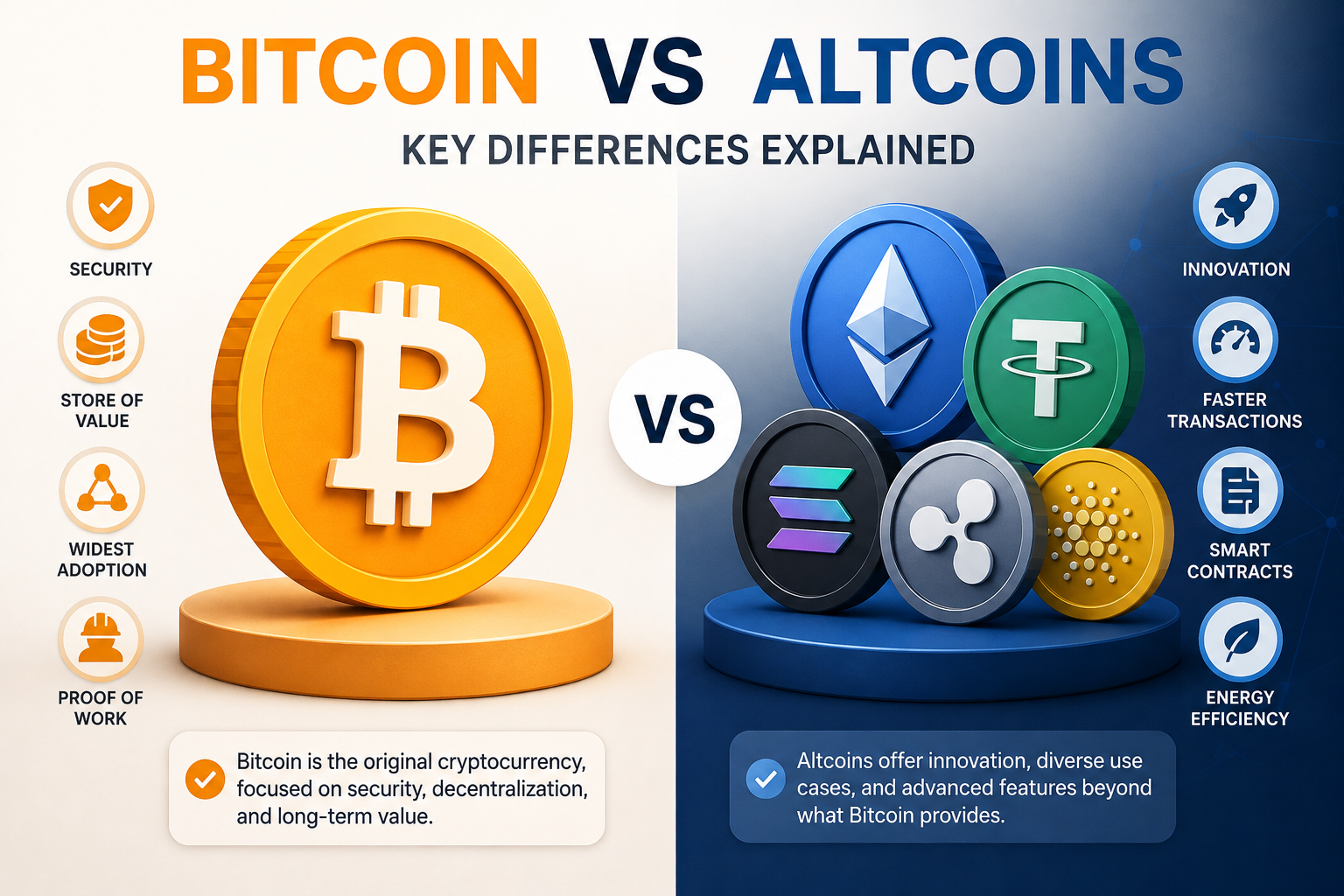
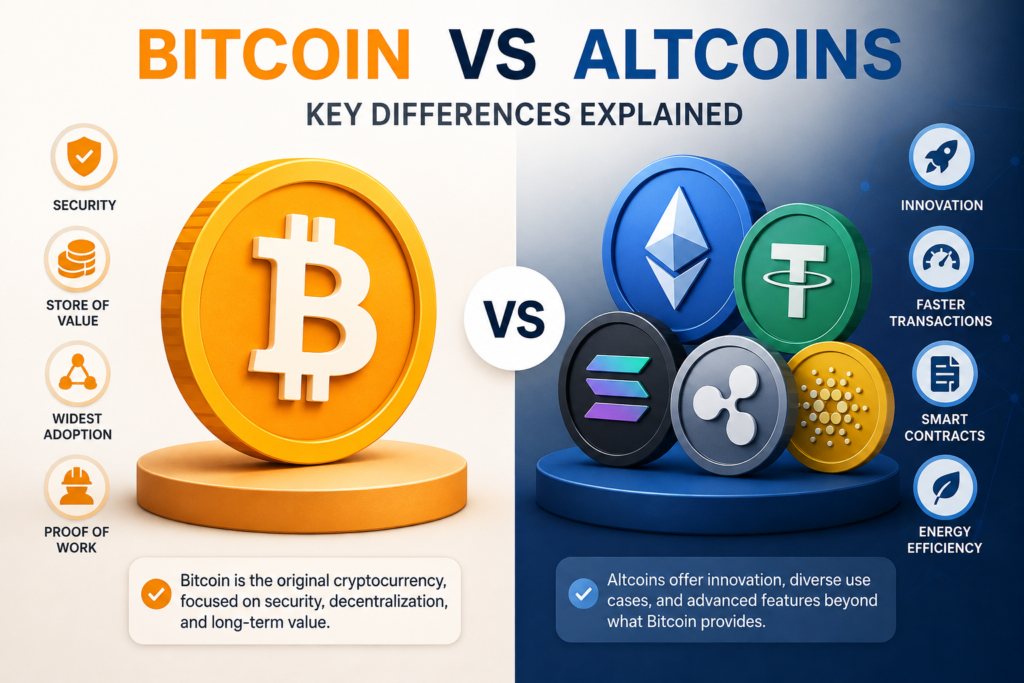
The biggest difference is that Bitcoin was created as a decentralized digital currency, while altcoins are designed for many different purposes.
Bitcoin mainly focuses on secure value transfer and long term wealth preservation.
Altcoins often introduce additional features such as smart contracts, decentralized applications, staking, governance systems, gaming ecosystems, or cross border payment solutions.
Because of this, Bitcoin is usually considered more stable, while altcoins offer more innovation but also carry greater risks.
Purpose
Bitcoin was designed to become an alternative financial system where people can send and receive money without intermediaries.
Many investors also use Bitcoin as a long term investment because of its limited supply.
Altcoins usually have more specialized purposes.
Ethereum allows developers to build decentralized applications.
Solana focuses on high speed transactions.
Ripple aims to improve international payments.
Chainlink connects blockchain networks with real world data.
Every major altcoin tries to solve a specific challenge that Bitcoin does not directly address.
Supply
One of Bitcoin’s biggest advantages is its fixed supply.
Only 21 million Bitcoins will ever exist. This limited supply creates scarcity, which many investors believe increases its value over time.
Altcoins have different supply models.
Some have unlimited supplies.
Some burn tokens regularly to reduce circulation.
Others increase supply through staking rewards.
This means every altcoin follows its own economic model, making it important to study tokenomics before investing.
Market Value
Bitcoin has remained the largest cryptocurrency by market capitalization for many years.
It usually represents a significant portion of the entire crypto market.
Because Bitcoin has been around longer, it enjoys greater trust among investors, institutions, and businesses.
Altcoins collectively represent a large portion of the market, but individually they are much smaller than Bitcoin.
Some altcoins become very popular for a period before losing momentum as newer projects emerge.
Technology
Bitcoin uses blockchain technology mainly for secure financial transactions.
Its network prioritizes security and decentralization over speed.
Altcoins often experiment with new technologies.
Some support smart contracts.
Some offer faster confirmation times.
Others use different consensus mechanisms that reduce energy consumption.
These innovations make altcoins attractive for developers building blockchain based applications.
Transaction Speed
Bitcoin transactions can sometimes take several minutes depending on network activity.
During periods of high demand, transaction fees may also increase.
Many altcoins were created to improve transaction speed.
Some cryptocurrencies can complete transactions within seconds.
Others process thousands of transactions every second, making them suitable for business applications and online services.
Security
Bitcoin has one of the strongest security records in the cryptocurrency industry.
Its massive global network makes attacks extremely difficult.
The longer Bitcoin exists, the more confidence people have in its security.
Altcoins can also be secure, but their security depends on the size of their networks and development teams.
Smaller cryptocurrencies may have weaker security because fewer computers validate their transactions.
Volatility
All cryptocurrencies experience price fluctuations.
However, Bitcoin is generally considered less volatile than most altcoins.
Altcoins often experience larger price swings.
A new partnership, software update, or social media trend can significantly increase an altcoin’s value within days.
Similarly, negative news can cause dramatic price drops.
This higher volatility creates opportunities for profit but also increases investment risk.
Adoption
Bitcoin has achieved the highest level of global recognition.
Many businesses accept Bitcoin payments.
Several investment funds hold Bitcoin.
Some countries even recognize Bitcoin in various legal or financial frameworks.
Altcoins continue growing in popularity, but adoption varies from one project to another.
Ethereum has widespread adoption among developers.
Ripple is popular among financial institutions.
Other altcoins may have smaller but highly dedicated communities.
Mining and Validation
Bitcoin uses Proof of Work to secure its blockchain.
Miners solve complex mathematical problems to verify transactions and earn rewards.
Some altcoins also use Proof of Work.
Others use Proof of Stake, where users lock their coins to help validate transactions and receive rewards.
Proof of Stake generally consumes much less electricity than traditional mining.
This difference has become an important factor for environmentally conscious investors.
Investment Risk
Bitcoin is often viewed as the safer cryptocurrency investment because of its long history, strong reputation, and widespread adoption.
Although Bitcoin prices still rise and fall, many investors consider it less risky than newer cryptocurrencies.
Altcoins usually involve higher risk.
Some projects deliver innovative technology and achieve remarkable success.
Others fail due to poor development, weak communities, or lack of practical use.
Before investing in any altcoin, I believe it is important to research the development team, project goals, community support, and long term roadmap.
Innovation
Bitcoin changes slowly because developers prioritize stability and security.
Major updates are carefully reviewed before implementation.
Altcoins evolve much faster.
Developers regularly introduce new features, improve network performance, and explore emerging blockchain technologies.
This rapid innovation drives the cryptocurrency industry forward but also increases uncertainty because not every experiment succeeds.
Community Support
Bitcoin has one of the largest and most loyal communities in the crypto industry.
Millions of investors, developers, businesses, and enthusiasts support its long term growth.
Altcoins also have active communities, but their sizes differ significantly.
Strong communities often contribute to project success by promoting adoption, developing applications, and supporting continuous improvements.
Should Beginners Choose Bitcoin or Altcoins
I believe beginners should first understand Bitcoin before exploring altcoins.
Bitcoin provides a solid foundation for learning how blockchain technology and cryptocurrency work.
After gaining experience, investors can explore carefully selected altcoins that have strong development teams and real world use cases.
Diversification can also reduce risk because relying on only one cryptocurrency may not always be the best strategy.
However, every investment decision should be based on personal financial goals, research, and risk tolerance.
Common Misconceptions
One common misconception is that all altcoins are better than Bitcoin because they offer newer technology.
While some altcoins provide advanced features, Bitcoin continues to dominate because of its security, trust, and limited supply.
Another misconception is that cheaper coins are better investments.
The price of a single coin does not determine its future potential.
Market capitalization, utility, adoption, and project quality are much more important factors.
Finally, many people think every altcoin will become the next Bitcoin.
In reality, thousands of cryptocurrencies have disappeared over the years, proving that careful research is always necessary.
Final Thoughts
After learning about cryptocurrencies, I realized that Bitcoin and altcoins both play important roles in the digital asset market. Bitcoin remains the pioneer and is widely trusted as a secure store of value with a limited supply and a strong global reputation. Altcoins, on the other hand, bring innovation by introducing smart contracts, faster transactions, decentralized applications, and many other features that expand the possibilities of blockchain technology.
From my perspective, Bitcoin is an excellent starting point for anyone entering the crypto world because of its stability and established history. Altcoins can offer exciting opportunities, but they also require more research since every project has different goals, technologies, and levels of risk.
In the end, understanding the differences between Bitcoin and altcoins helps investors make smarter decisions. Instead of following market hype, I believe it is always better to focus on knowledge, patience, and proper research before investing in any cryptocurrency.